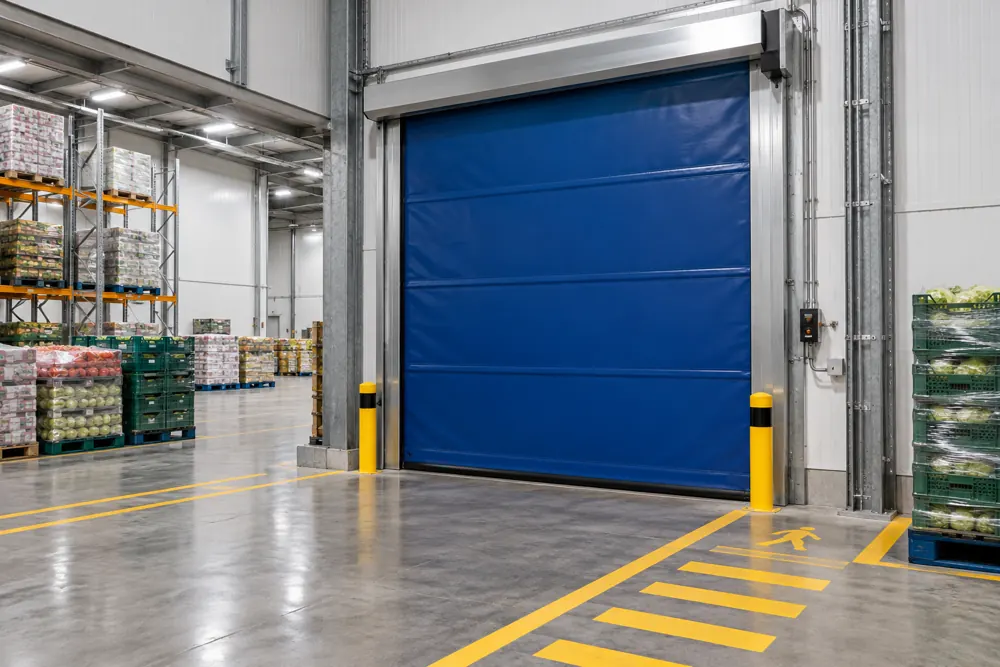
Where High Speed Doors Fit
High speed doors can suit busy internal routes, distribution buildings and openings where a slow door interrupts repeated traffic. They can help limit the time an opening remains exposed between movements. The benefit depends on the operating pattern, rather than speed being a useful feature on every door.
First establish how many movements occur, what passes through and whether the opening separates different environments. A route used by forklifts needs a different assessment from a lightly used service corridor. A faster moving curtain also makes suitable controls and protective measures particularly important.
Internal And External Openings
An internal door may separate working zones, while an external opening must also respond to weather and security requirements. Some flexible door systems are intended for sheltered or internal use. The product selection needs to match the proposed position rather than treating all high speed doors as interchangeable.
Explain draughts, washdown, temperature differences and any need for visibility through the curtain. Where temperature control is part of the brief, ask how seals and the surrounding opening will perform. Do not assume a high speed curtain alone gives the same thermal or security performance as another door type.
Traffic Detection And Controls
Activation can involve a local control or a detection arrangement selected for the route. The aim is to recognise intended traffic without causing unnecessary opening. Discuss vehicle direction, approach angles and nearby pedestrian movement before choosing detection positions.
An activation device is not automatically a safety device. The protective system must address hazards independently of the method used to request opening. If vehicles queue close to the doorway or reverse near it, that behaviour needs to be included in the assessment before a control layout is agreed.
Assess The Complete Route
The clear opening needs to suit the largest normal load, not only the vehicle body. Check the approach, turning space and visibility on both sides. Racking, blind corners and changes of floor level can affect how drivers approach the door and whether they can stop safely.
Separating pedestrians from vehicle movement is preferable to expecting everyone to judge a fast-moving opening. Tell us if an adjacent pedestrian route exists or if staff routinely walk through the vehicle doorway. Floor markings and instructions have a role, but they cannot replace suitable physical and control measures.
Installation And Long-Term Support
The survey should confirm the supporting structure, power requirements, mounting clearances and maintenance access. Controls may need to coordinate with another door or process. Agree those interfaces in writing so the installation scope includes the required testing and responsibilities.
Ask about replacement curtain sections, safety components and support for the chosen control system. Frequent operation makes repair access and parts availability practical purchasing questions. Where the opening is essential to production, consider what alternative route can be used while the door is unavailable.
Cost And Specification Questions
Door size, curtain construction, environment, activation method and protective equipment all affect the quotation. Structural preparation, electrical work and integration with other systems may be separate items. Compare the complete installed scope, rather than using an opening-speed figure as the main measure of value.
Send the postcode, photographs of both approaches and a description of the traffic. Explain whether the project is a replacement, a new partition opening or an external entrance. Include operational problems you want to solve so the proposed door can be assessed against a clear purpose.
Safety And Workplace Responsibilities
Powered doors need suitable risk assessment and protective measures. HSE guidance on powered doors explains why a standard alone does not settle every risk. The BS EN 12453:2017+A1:2021 standard concerns safety in use of power-operated doors.
The Workplace (Health, Safety and Welfare) Regulations 1992, regulation 18 addresses door and gate safety. PUWER 1998 also covers work equipment. Ask for the relevant assessment, checks and instructions for your actual installation.
Your Next Steps
- Identify the door and send the postcode, symptoms or project requirements.
- Agree any survey and define the repair, installation or maintenance scope.
- Confirm price, access arrangements, documentation and timing before booking.
Frequently Asked Questions
Can A High Speed Door Provide Overnight Security?
A high speed door’s overnight security performance depends on the specific product and installation. A flexible curtain intended for internal traffic management should not be assumed to replace a security shutter. State your security requirements and any insurer’s conditions so the proposal can include a suitable external closure if needed.
Can High Speed Doors Use Automatic Detection?
High speed doors can use suitable automatic activation systems where the route and risk assessment support them. Detection must suit vehicle approaches and the surrounding activity. Opening activation and protective devices have different jobs, so the design needs to consider both before the door is commissioned for use by staff and vehicles.